
ALPA Holds Its Fifth Annual Conference, Third In Exile
October 29, 2026
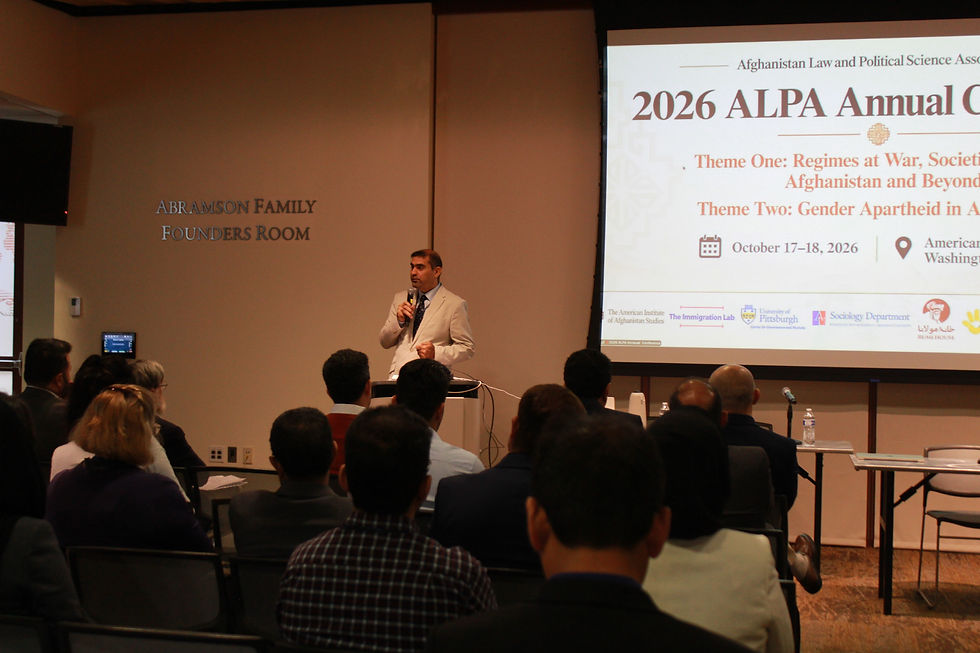
From October 16 to 18, 2026, the Afghanistan Law and Political Science Association (ALPA) held its 2026 Annual Conference at American University in Washington, DC. The gathering brought together scholars in person and online for three days of research, discussion, and exchange on Afghanistan and the wider region.
The conference program featured 17 panels and plenary sessions on Afghanistan’s political, legal, economic, social, and cultural life, as well as the experiences of Afghans in exile. In total, 110 researchers contributed to the conference and 91 draft or published papers and books were presented. Five panels were conducted fully or partly in Afghanistan’s local languages and included around 26 presenters. Approximately 250 people took part in the conference.
Participants came from North America (40 percent), Europe (33 percent), Asia (23 percent), and Oceania (3 percent). The hybrid format helped scholars join from different regions and circumstances. Early career researchers had the opportunity to present their work, exchange ideas with established scholars, and connect with potential publishers. Women made up 47 percent of the researchers, and men 53 percent. ALPA is proud that women’s representation reached its highest level at an academic conference on Afghanistan.

Two themes, many perspectives
The program centered on two themes. “Gender Apartheid in Afghanistan” examined women’s exclusion from education, employment, and public life. Heather Barr, Associate Director of the Women’s Rights Division at Human Rights Watch, delivered the keynote address.
The second theme, “Regimes at War, Societies in Crisis: The Interconnectedness of Wars and Legitimacy Crises in the Region,” considered Afghanistan in the context of wider regional conflict and political crisis. Dr. Mirwais Balkhi, former Minister of Education of Afghanistan, delivered the keynote address. Together, the themes invited discussion of Afghanistan’s challenges within both national and regional contexts.
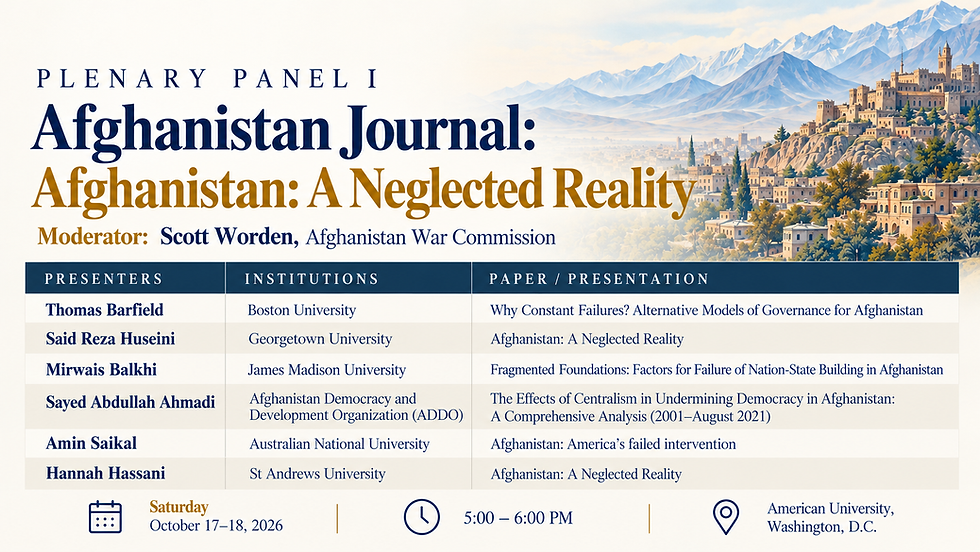
Two plenary sessions brought these themes into focus. The first, “Afghanistan: A Neglected Reality,” was organized in collaboration with Afghanistan Journal. Moderated by Scott Worden, it brought together Thomas Barfield, Said Reza Huseini, Hannah Hassani, Mirwais Balkhi, Sayed Abdullah Ahmadi, and Amin Saikal, whose articles appeared in a special issue of the journal. The panel examined why international forces and the Afghan state failed to establish peace and stability. It also considered historical models of governance in the region that functioned successfully but received limited attention in post 2001 state building efforts.
The second plenary, “Gender Apartheid: A Multidimensional Analysis,” was moderated by Metra Mehran and featured Halima Kazem, Omar Sadr, Tahmina Sobat, Aryana Mahmod, and Nazeela Elmi. The panel examined gender apartheid through legal, political, cultural, and social perspectives, with discussion of intersectionality, women’s legal advocacy, accountability, and solidarity.
Other sessions addressed Taliban rule, civil and political resistance, law, the economy, public institutions, borders, security, relations with neighboring countries, and international intervention. Presenters also examined migration and diaspora communities, media, youth expression, education, religion, literature, nationalism, and historical memory. Book talks explored women, peace, and Afghanistan’s changing public sphere.
The conference also hosted two roundtables. Rawadari convened a discussion on the effects of Pakistan’s military attacks on civilians in Afghanistan. The Afghanistan Dialogue and Visioning Process (ADVP) held a roundtable on Afghanistan’s five years under Taliban rule. Women’s rights and education appeared throughout the program, including in panels on girls’ education, women’s resistance, and the effects of exclusion.
Supporting research and publication
The conference began on Friday, October 16, with a research workshop organized by RC4, ALPA’s Research Committee on History and Society in Afghanistan. Led by Dr. Said Reza Huseini, the workshop, “Re-thinking Afghanistan: Narratives, History, and the Search for a Connected Past,” brought seven draft papers before expert reviewers Thomas Barfield, Jonathan Lee, and Amin Saikal. The authors received feedback on their arguments and an opportunity to revise their work.

The publication exhibition highlighted work that grew from conversations at the 2025 ALPA Annual Conference. At that conference, the directors and editors in chief of Afghanistan Journal, the ALPA Journal of Interdisciplinary Studies, and Artak, Rumi House’s Artak Journal, took part in a workshop on academic publishing. The editors of the latter two publications discussed plans to launch their journals.
This year’s exhibition featured the first volume of the ALPA Journal of Interdisciplinary Studies, a volume of Artak, and the latest volume of Afghanistan Journal, which has attracted considerable public attention. These publications mark important achievements for their journals and for ALPA.
The awards session recognized outstanding publications and civic contributions. Nivi Manchanda received the Best Book in English Award for Imagining Afghanistan: The History and Politics of Imperial Knowledge. Said Reza Huseini received the Best Article in English Award for “Local Government Reflected in Bactrian Documents.”

Geety Haidary, Fatima Moqadam, Roya Muqsit, and Regina Ahmadzai received the Jon Eddy Award for Civic Excellence. Michael Sullivan received the Jon Eddy Award for Excellence in Teaching at ALPA College of Liberal Arts and Sciences. The recipients of the awards for books and articles in Persian and Pashto will be announced soon.
The conference was more than three days of presentations. It created new connections, opened opportunities for research and publication, and brought scholars together across countries and disciplines. We hope participants will carry these conversations forward through continued collaboration and ALPA’s research committees.


Comments