
Reflections from “Five Years Under Taliban Rule”: Repression, Global Silence, and Afghanistan’s Resilience
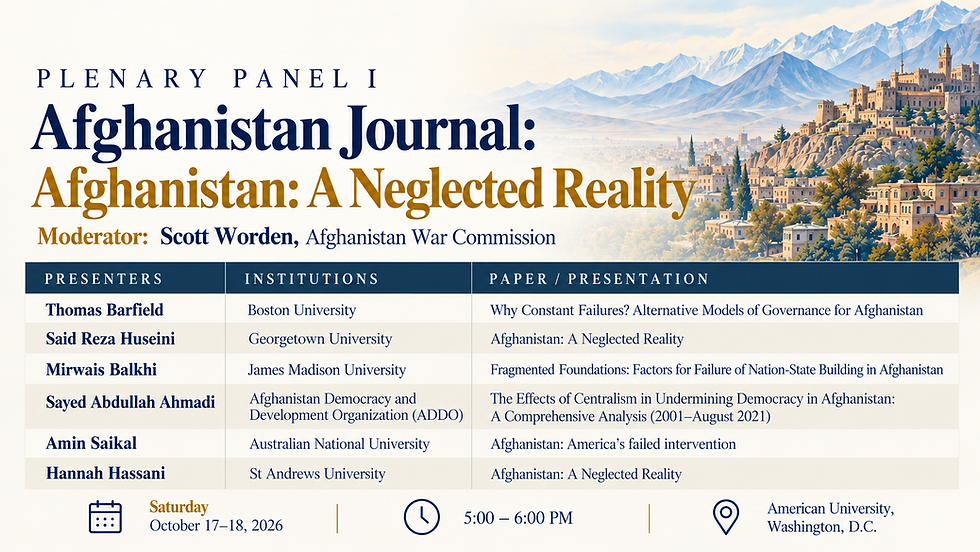
On August 14, 2026, scholars, diplomats, journalists, human rights advocates, students, practitioners, and members of the Afghan diaspora gathered at American University in Washington, D.C., for the conference “Five Years Under Taliban Rule: Repression, Global Silence, and Afghanistan’s Resilience.” The event was organized by Rumi House, ALPA, Immigration Lab, Center for Latin American and Latino Studies, AFCAR, Negotiating Ideas, AIMED, and ACPIS.
The conference marked five years since the Taliban returned to power in Afghanistan. It was not simply a commemoration of a tragic anniversary. It was an attempt to confront a painful reality: Afghanistan has lived under one of the most repressive political orders in the world, while much of the international community has slowly learned to look away.

The discussions examined the political, security, social, and human rights consequences of Taliban rule, with particular attention to the lives of women and girls. Over the past five years, Afghan women have been pushed out of schools, universities, workplaces, public offices, public parks, courts, media spaces, and most areas of public life. The Taliban’s rule has not only restricted women’s rights. It has tried to erase women as full members of society.
But women are not the only victims of this order. Journalists, activists, former government employees, artists, ethnic and religious minorities, civil society workers, and ordinary citizens have lived under fear, censorship, surveillance, poverty, and displacement. The Taliban’s return did not merely replace one government with another. It changed the conditions of life itself. It turned the country into a place where silence is often necessary for survival.
The conference also raised a difficult question about the world’s response. Five years after the fall of Kabul, Afghanistan is no longer treated with the urgency that the crisis demands. Governments and international organizations continue to speak about human rights, women’s education, and inclusive governance, but these words have too often remained detached from serious political consequences. The gap between moral language and political action has become one of the most painful features of the Afghan tragedy.

One of the central concerns of the conference was the growing normalization of Taliban rule. Many international actors now treat the Taliban as an unavoidable political reality. Of course, Afghanistan cannot be ignored, and humanitarian engagement remains necessary. But engagement without accountability can easily become acceptance. A regime that excludes women, silences dissent, governs without democratic legitimacy, and punishes difference should not be rewarded with political normalization.
At the same time, the conference refused to reduce Afghanistan only to suffering. A major theme of the gathering was resilience. Despite repression, Afghans inside and outside the country continue to teach, write, organize, document abuses, support students, preserve memory, and imagine a different future. Afghan women continue to learn in hidden classrooms and online spaces. Afghan scholars continue to produce knowledge in exile. Civil society has been wounded, but it has not disappeared. These efforts may not always make headlines, but they keep alive the possibility of another Afghanistan.
The event also created space for the Afghan diaspora to reflect on its own responsibilities. For many Afghans outside the country, the last five years have been marked by grief, anger, helplessness, and distance. But exile does not have to mean silence. The diaspora has access to universities, media, policy institutions, civic organizations, and public platforms. These spaces can be used to keep Afghanistan visible and to challenge the politics of forgetting.

One of the most important messages of the conference was that documentation must be connected to action. Reports, testimonies, and evidence matter. They preserve truth in a time when the Taliban tries to control memory and narrative. But documentation alone is not enough. It must lead to public responsibility, institutional pressure, and policy choices that do not sacrifice the rights of Afghans for the convenience of diplomatic engagement.
The conference did not offer easy answers. Afghanistan’s crisis is too deep for slogans, and the path forward remains uncertain. But it offered something important: a serious conversation at a time when silence has become dangerous. It reminded participants that forgetting Afghanistan is not a neutral act. It is a political and moral failure.
Five years under Taliban rule have shown the cost of abandonment. They have also shown the courage of those who continue to resist erasure. The task now is to make sure Afghanistan does not disappear from public conscience, scholarly debate, or policy discussion. The people of Afghanistan deserve more than sympathy after tragedy. They deserve sustained attention, principled solidarity, and a future in which freedom, dignity, and justice are again possible.

Comments